Glossary

The fitness glossary. Short, honest explanations.

The key terms from training, nutrition and coaching, from AMRAP to Zone 2. For everyone who trains and everyone who coaches.

47 terms from A to Z

What is a deload, how much protein do you really need, and what awaits you at the last Hyrox station? You'll find the answers here, explained briefly and with numbers we have checked.

Every term has its own link to share. Jump to a letter using the bar at the top, or pick a topic here.

A

AMRAP

Short for “as many rounds as possible”: in a set time, for example twelve minutes, you complete as many rounds of a circuit as you can. Your result is the rounds and reps you managed.

Because the time and exercises are fixed, you can repeat the same AMRAP weeks later and see in black and white whether you have got fitter. In strength training, AMRAP also means a single set with as many reps as possible, often as the last set of an exercise.

See also EMOM HIIT Training diary

Ava

The AI assistant in Fitiva. She knows your plan, your goal and your history, logs meals from one sentence, factors in your whole day and answers your questions between sessions.

For coaches, Ava drafts workouts, and from Pro on also nutrition plans and programmes spanning several weeks. She flags athletes who haven't trained for a while and sums up check ins. Ava prepares, the coach decides with a single tap. She is part of every plan and replaces neither your coach nor a doctor. Everything she can do is on the page for athletes and in the article What the AI can do between your sessions (in German).

See also Check in Nutrition plan Training plan

B

Burpee Broad Jumps

A burpee, meaning down into the push-up position with your chest on the floor and back up again, followed by a broad jump forwards off both feet. That way you work your way across a distance, jump by jump.

At Hyrox this is the fourth station, over 80 metres. Your chest has to touch the floor every time (as of September 2026). The exercise works your legs, shoulders and heart rate all at once and takes more out of you than the short distance suggests.

See also Hyrox Wall Balls

C

Check in

The regular update to your coach, usually once a week: weight, sleep, stress, energy, mood and how well your nutrition went. Often the check in, not the session itself, is the moment a plan gets adjusted.

In Fitiva your coach builds their own form, with their own questions and a rhythm from weekly to monthly, and you answer in the app. On top of that there's a short daily check in on your dashboard, with mood, sleep, stress and energy.

See also Online coaching Training diary Streak

D

Deload

A planned week with clearly less training volume or intensity. Your body catches up on the recovery that has piled up over hard weeks, and you start the next block fresher.

Many coaches schedule a deload every four to eight weeks, others only when performance, sleep or motivation noticeably drop. Typically that means far fewer sets at similar or slightly lighter weights.

See also Periodisation Volume Tapering

E

EMOM

Short for “every minute on the minute”: at the start of every minute you do a set exercise for a set number of reps, and the rest of the minute is rest. The faster you finish, the more rest you get.

EMOMs are great for practising technique under light fatigue and holding an even pace. An example: ten kettlebell swings at the start of every minute for ten minutes.

See also AMRAP HIIT

Nutrition plan

A structured guide to meals, amounts or macronutrients that fits your goal, your everyday life and your taste. A good plan leaves room to move and gets adjusted at the check in if it doesn't work in everyday life.

In Fitiva your coach assigns you the plan right in the app; from the Pro plan on, they can have Ava write the draft and then adjust it. Ava puts together your shopping list from the plan. With Premium you also get a nutrition plan from Ava every month, even without a coach.

See also Macros Calorie deficit Check in

F

Farmers Carry

Carrying heavy weights in both hands over a distance, upright and with a steady core. Trains grip strength, core, shoulders and posture.

At Hyrox the Farmers Carry is the sixth station: 200 metres with two kettlebells, from 2 × 16 to 2 × 32 kilograms depending on the division (as of September 2026). Putting them down is allowed, but it costs time.

See also Hyrox Sled Push and Sled Pull

G

Basal metabolic rate

The energy your body uses in a day at complete rest, for breathing, heart, brain and body temperature. For most people it is the biggest item in their daily energy use.

Together with everyday movement, training and digestion, it makes up your total energy expenditure. It is estimated with formulas based on weight, height, age and sex, such as the one by Mifflin and St Jeor. That is also how Fitiva works out your calorie target, if you agree. If the app knows your body fat percentage, it calculates with your fat-free mass.

See also Energy balance NEAT Body fat percentage

H

HIIT

Short for “high intensity interval training”: short, very hard efforts alternating with breaks, for example 30 seconds flat out and 90 seconds easy. A session often lasts just 15 to 30 minutes.

HIIT raises your VO2max within just a few weeks, but it is very demanding. That's why many endurance plans combine a few hard sessions a week with lots of easy training in Zone 2.

See also VO2max Zone 2 EMOM

Hybrid coaching

The mix of in-person sessions and online coaching with a plan, check in and chat. In person you learn the technique, and in between the plan in the app keeps you on track.

For many people it's the best middle ground between results and price: you don't pay for every session with the coach, and you still don't train alone. More in the article Online, in person or hybrid (in German).

See also Online coaching Personal training Check in

Hypertrophy

Muscle growth: the individual muscle fibres get thicker. The stimulus comes from sets taken close to muscle failure; the muscle can only grow with enough protein, energy and sleep.

Studies show muscle growth with heavy and light weights alike, as long as the sets get close enough to failure. Many plans work with 6 to 20 reps because that range is easy to progress. What matters is that the load increases over weeks.

See also Progressive overload Muscle failure Volume Macros

Hyrox

A fitness race with a fixed format: you run one kilometre eight times, and each kilometre is followed by a station. Because the distances and stations are the same everywhere, times can be compared worldwide.

The stations in order: 1,000 metres SkiErg, 50 metres Sled Push, 50 metres Sled Pull, 80 metres Burpee Broad Jumps, 1,000 metres rowing, 200 metres Farmers Carry, 100 metres Sandbag Lunges and 100 Wall Balls. The weights depend on the division, and the current rulebook is available from the organiser (as of September 2026). How to prepare is covered in the article Preparing for Hyrox with a coach (in German).

See also Farmers Carry Sled Push and Sled Pull Wall Balls Tapering

I

Intermittent fasting

You only eat within a set time window and fast in between. A well-known version is 16:8, meaning 16 hours without food and 8 hours in which you eat. Water, unsweetened tea and black coffee are allowed while you fast.

Intermittent fasting helps with weight loss mainly because many people eat less in the shorter window; studies find similar results to a classic calorie deficit. In Fitiva the fasting timer shows you how long ago your last logged meal was. If you are pregnant or have diabetes or an eating disorder, talk to your doctor first.

See also Calorie deficit Energy balance

K

Calorie deficit

You take in less energy than you use. Your body takes the rest from its stores, and you lose weight.

A moderate deficit of about 300 to 500 kilocalories a day is manageable for most people. As a rough rule of thumb, one kilogram of body fat holds around 7,000 kilocalories, so 500 a day adds up to about half a kilo a week. In practice it is often slower, because your energy use drops along with your weight. Very large deficits make it hard to keep your muscle and to stick with it.

How a coach helps with this is covered in the article Losing weight with a personal trainer (in German). How to keep an eye on your food without chasing calories is in Tracking food without chasing numbers (in German).

See also Energy balance Basal metabolic rate Macros Intermittent fasting

Body fat percentage

The share of your body weight that is fat, in per cent. It says more about your shape than weight alone: two people with the same weight can look very different.

It can be measured with skinfold callipers, body fat scales or in a lab, for example with a DEXA scan. Scales fluctuate a lot with your fluid balance, so what counts is the trend over weeks, measured under the same conditions. In Fitiva you log weight, body fat and progress photos.

See also Basal metabolic rate Calorie deficit Hypertrophy

L

Lactate threshold

The intensity at which lactate starts to build up in your blood. At the first threshold the value rises above the resting level for the first time; at the second, more lactate is produced than the body can clear, and the pace can only be held for a limited time.

Both thresholds can be determined with a step test and small blood samples. Coaches use them to work out training zones, for example Zone 2.

See also Zone 2 VO2max

M

Macros

Short for macronutrients: protein, carbohydrates and fat. They provide almost all the energy in food, and their ratio helps decide how full you feel and how well you recover from training.

Protein and carbohydrates provide around 4 kilocalories per gram, fat around 9 and alcohol around 7. That is also how nutrition labels on food in the EU are calculated. The DGE (German Nutrition Society) recommends 0.8 grams of protein per kilogram of body weight a day for adults up to 65 years of age. If you train hard, you need more: a DGE position paper gives 1.2 to 2.0 grams.

In Fitiva, Ava estimates the macros when you describe your food in one sentence. If you search for a food, branded products come with the values from their label on Open Food Facts.

See also Nutrition plan Calorie deficit Hypertrophy

Mobility

Active flexibility: the range of motion you can control with your own strength, not just the one you can be stretched into.

It is trained with controlled movements through the full range of motion, often under a light load, for example deep squats with a pause at the bottom. Stretching is part of it, but on its own it usually isn't enough. Good mobility helps you perform exercises like squats or overhead presses cleanly.

See also Reformer Pilates Progressive overload

Muscle soreness

Pain and stiffness in a muscle that start 12 to 24 hours after unfamiliar training and peak after 24 to 72 hours. The cause is thought to be tiny injuries in the muscle and its connective tissue, especially after braking movements such as running downhill or slowly lowering a weight. It has nothing to do with lactate.

Muscle soreness is not a measure of good training: people who train regularly get it less often and still make progress. It goes away by itself, and light movement usually does more good than complete rest. If severe pain doesn't ease off, get it checked by a doctor.

See also Deload Sled Push and Sled Pull

Muscle failure

The point in a set at which, despite full effort, you can't manage another clean rep.

For muscle growth, sets need to get close to this point, but not every set has to go all the way. Many coaches leave one to three reps in the tank, measured with RIR or RPE, and only go to failure on safe exercises.

See also RIR RPE Hypertrophy

N

NEAT

Short for “non exercise activity thermogenesis”: the energy you use for movement outside of sport, such as walking, climbing stairs, standing or housework.

NEAT varies a lot from person to person, by several hundred kilocalories a day depending on job and lifestyle. On a diet it often drops without you noticing, because you move less. That's why it pays to watch your everyday steps when you're in a deficit.

See also Energy balance Basal metabolic rate Calorie deficit

O

Online coaching

Coaching without in-person appointments: a plan in the app, a regular check in, chat or video. Usually cheaper than training in person and not tied to one place, but it takes self-discipline and clean technique.

In Fitiva your coach sends the plan straight to your app, and your workouts and meals go to them, no screenshots. What the different models cost is covered in the article What does personal training cost? (in German)

See also Hybrid coaching Check in Personal training

Online course

A course that a coach builds once and then sells as often as they like, with lessons made of text, images and files. You work through it at your own pace, with no appointments at all.

In Fitiva the training or nutrition plan is attached right in the lesson, the coach can unlock individual lessons as a free preview, and you can buy through their link even without an account. For coaches, course sales have a fee ladder of their own that drops as revenue grows, down to as little as 6%.

See also Package Training plan

P

Package

Several sessions at a fixed price, such as a 10 session pass. Usually cheaper per session than booking single sessions, but you commit to several appointments.

In Fitiva coaches sell packages through their profile or a payment link. You pay online and book each session with a credit from the package; you can see in the app how many are left.

See also Personal training Online course

Periodisation

Planning your training in phases, each with its own focus, for example first base and technique, then build-up, then intensity and finally a test or competition.

That way the load rises in a targeted way, recovery is built in, and you are in shape at the right moment. Blocks of a few weeks are common, often with a deload at the end and a taper before the competition.

See also Training plan Deload Tapering Progressive overload

Personal training

One-to-one coaching by a coach, in person, online or hybrid. You get training tailored to you and someone who keeps an eye on your technique.

Every coach sets their own prices. According to the Bundesverband Personal Training (German Federal Association for Personal Training), the range in Germany is €35 to €180 an hour, and the association recommends at least €95 (as of September 2026). Packages that include coaching are usually cheaper per session. More in the article What does personal training cost? (in German)

In Fitiva you find coaches near you on the map, see their prices before you book and pay online or on site.

See also Hybrid coaching Online coaching Package

Progressive overload

The basic principle behind all training progress: you increase the load over weeks so your body has a reason to keep adapting.

You can increase the weight, reps, sets, range of motion or density, meaning less rest. Without a record that's hard to manage, which is why a training diary is part of it. In Fitiva the app spots new records by itself.

See also Training diary Hypertrophy Volume One rep max

R

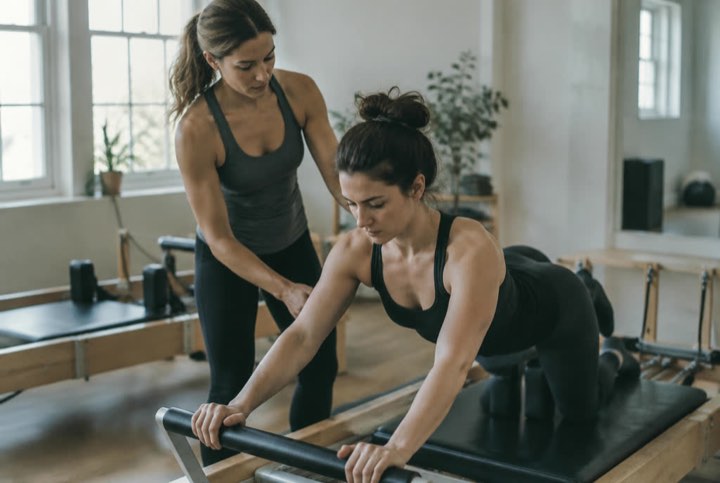
Reformer Pilates

Pilates on a machine called the reformer: a frame with a carriage that glides on rails, with springs providing the resistance. Trains core, body control and flexibility.

Because the resistance can be finely adjusted with the springs, Reformer Pilates suits beginners and advanced athletes alike and is popular alongside strength training or running. In Fitiva you book available reformer classes with Pilates coaches yourself and pay for packages online.

See also Mobility Package

RIR

Short for “reps in reserve”: how many more reps you could have done at the end of a set. RIR 2 means two more clean reps would have been possible.

RIR is the counterpart to the RPE scale in strength training: RIR 2 equals RPE 8. With a bit of practice you can estimate it quite accurately, ideally on sets that end close to muscle failure.

See also RPE Muscle failure

RPE

Short for “rating of perceived exertion”, how hard an effort feels. In strength training you rate a set on a scale from 1 to 10; RPE 8 means two more reps would have been possible.

Coaches use RPE to adjust plans to how you feel on the day instead of prescribing fixed weights: on a good day the weight for RPE 8 is higher, on a tired day lower. In endurance sport the Borg scale from 6 to 20 is also common.

See also RIR Muscle failure One rep max

Run club

An open running group that meets regularly at a fixed meeting point, usually without a fee and often with groups for different paces. For many people the easiest way to stay consistent and meet people.

In Fitiva coaches set up run clubs and other events, free or ticketed, and you find them near you on the map or as a list. At launch, coaches and events are in Germany, Austria and Switzerland. More in the article Running in a group (in German).

See also Zone 2 Streak

S

Streak

In Fitiva, the number of days in a row you have been active. Every day with a workout, a logged meal or your check in counts, whatever the sport.

Your streak makes habits visible: not every day has to be a hard training day, but every day counts. Fitiva reaches out when your streak could break, and you set your own quiet hours.

See also Training diary Check in

Sled Push and Sled Pull

Pushing a loaded sled over a distance or pulling it towards you with a rope. Legs, core and back work together, with almost no braking movement.

Because there is hardly any braking work, you get little muscle soreness, and the technique is quick to learn. That's why the sled is also popular in athletic training and rehab training. At Hyrox, Sled Push and Sled Pull are the second and third stations, each over 50 metres.

See also Hyrox Farmers Carry Muscle soreness

Sprint

A short, clear goal with a timeline, for example 5 kilometres in under 25 minutes within six weeks. Many people stick with short stages and visible progress better than with a plan that runs for half a year.

In Fitiva your coach sets up a sprint for you. Many goals move by themselves, such as weight with every measurement or strength with your heaviest set; you and your coach enter your own goals by hand. You see how much you have already achieved, and your coach sees at a glance who is ahead and who is falling behind. More in the article The 4 week sprint (in German).

See also Training plan Periodisation

Superset

Two exercises straight after each other, and only then a rest. It saves time and makes your training denser.

It works best with opposing muscles, as with bench press and rows, because performance barely suffers. If both exercises hit the same muscle, the second one gets noticeably harder; some people use that on purpose.

See also AMRAP Volume

Supplements

Dietary supplements such as vitamin D, creatine or omega-3 fatty acids. Legally they are food, not medicine; they add to a balanced diet but do not replace it.

Whether a product does anything for you depends on your needs: for some there is good evidence, for many there isn't. For vitamins and minerals, the Bundesinstitut für Risikobewertung (BfR, German Federal Institute for Risk Assessment) proposes maximum amounts per daily dose. In Fitiva, Ava answers your questions about supplements with evidence from the BfR and EFSA, and you tick off your supplements every day. If you take medication or have a pre-existing condition, talk to your doctor first.

See also Macros Nutrition plan

T

Tapering

The last one to three weeks before a competition, when you train much less but keep the intensity. That way you reach the start line rested and in shape.

Typically you roughly halve the volume and keep short, intense sessions. New exercises or making up missed training have no place in a taper. What that looks like before a race is covered in the article Preparing for Hyrox with a coach (in German).

See also Periodisation Deload Hyrox

Training plan

The plan for the next few weeks, often four to twelve, with exercises, sets, reps and a clear progression, matched to your goal, your time and your equipment.

A good plan doesn't just tell you what to do today, but also how things carry on in three weeks. What it should include is covered in the article Getting a training plan built (in German). In Fitiva your coach sends the plan straight to your app. Without a coach, Ava builds you a routine in a minute; plans spanning several weeks come with Premium.

See also Periodisation Progressive overload Deload

Training diary

The record of your workouts: exercise, sets, reps, weight and how hard it felt. Without a diary you don't know what you managed last time and can't progress in a targeted way.

In Fitiva you log set by set with a rest timer, and the app spots new records by itself. With Premium you describe a workout in one sentence, and Fitiva turns it into exercises with sets and weights. A step-by-step guide is in the article Tracking workouts (in German).

See also Progressive overload Volume RPE

V

VO2max

The maximum amount of oxygen your body can take in and use per minute, usually given in millilitres per kilogram of body weight per minute. It is one of the most important measures of endurance performance.

It is measured precisely in a lab with breath gas analysis on a treadmill or bike; sports watches estimate it from heart rate and pace. It rises with intense intervals and lots of easy base training, and part of it is genetic.

See also HIIT Zone 2 Lactate threshold

Volume

How much you train. Usually counted as the number of hard sets per muscle group per week, sometimes as weight times reps, added up across all sets.

More volume brings more muscle growth up to a point, and after that mainly more fatigue. A figure often quoted is 10 to 20 hard sets per muscle per week. After every strength workout, Fitiva shows you your volume in kilograms.

See also Hypertrophy Deload Progressive overload

W

Wall Balls

A squat with a medicine ball: as you stand up, you throw the ball at a target mark on the wall. You catch it and go straight into the next squat.

At Hyrox, Wall Balls are the last station: 100 reps, with women throwing to 2.70 metres and men to 3 metres, using a ball of 4 to 9 kilograms depending on the division (as of September 2026). After eight kilometres and seven stations, many people underestimate how long 100 throws can take.

See also Hyrox Burpee Broad Jumps

Wearable

A watch, ring or chest strap that records heart rate, sleep and activity. Useful for trends over weeks; individual values such as calories burned or VO2max are estimates.

Fitiva will soon connect with Strava and Apple Health. Your runs and rides will then land in your diary by themselves, and your coach will see them too.

See also VO2max Training diary

One rep max

The weight you can move cleanly exactly once in an exercise, 1RM for short, from “one rep max”. It is the standard measure of your maximum strength.

Many plans give weights as a percentage of it, for example 75% of your 1RM. Instead of testing it at some risk, you can estimate it from a heavy set with a few reps. With RPE or RIR you can do without it entirely.

See also RPE RIR Progressive overload

Z

Zone 2

An easy endurance intensity at which you can still talk in full sentences. It sits just below or at the first lactate threshold.

Training in Zone 2 builds your base endurance, improves how well your muscles burn fat and puts little strain on you, so you can do a lot of it. Many people run their easy sessions too fast and end up above it. Exactly where the zone lies depends on the zone model; a performance test pins it down for you.

See also Lactate threshold VO2max HIIT Run club

Not medical advice. Figures on calories, protein and training are common recommendations for healthy adults, not advice for your individual case. If you have a pre-existing condition, are pregnant or take medication, talk to your doctor before making changes.

Missing a term, or is something unclear? Write to us and we'll add it to the glossary.

Keep reading

More on this topic

All articles

With a coach4 min read

What does personal training cost? (in German)

Single session, package or online coaching: how coaches in Germany charge, what drives the price and how to compare offers fairly.

Leon Fischer-Brocks